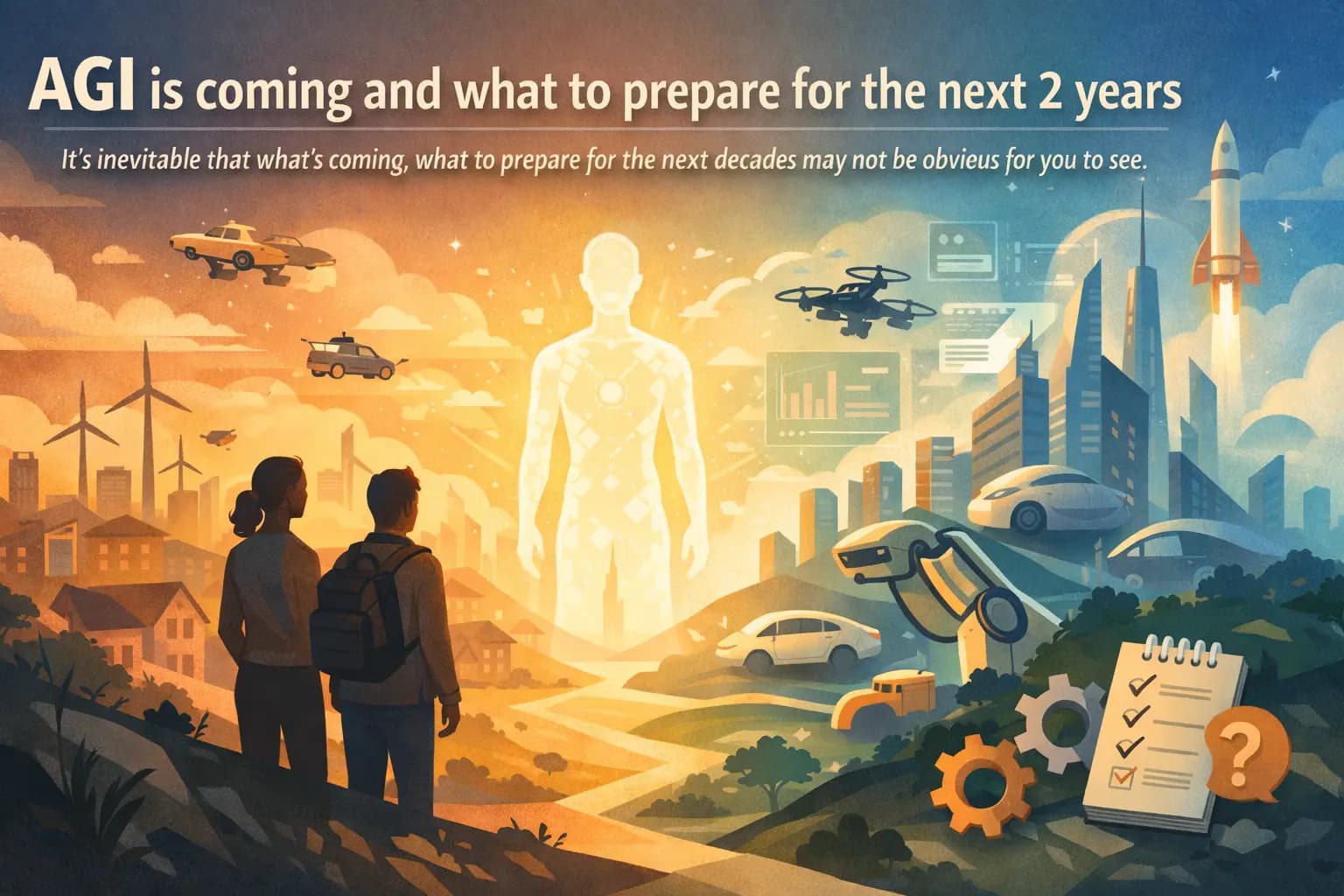
There’s a scenario making rounds recently — the “2028 Global Intelligence Crisis” by Citrini Research.
It’s not a prediction. It’s a thought experiment.
But it forces one uncomfortable question:
What if AGI arrives faster than society can adapt?
I’ve been thinking deeply about this — and here’s my view.
1. AGI / ASI Will Accelerate Every Field
Not just tech.
Not just coding.
Every field.
If Artificial General Intelligence (AGI) — and eventually Artificial Superintelligence (ASI) — becomes real, the impact won’t be linear. It will be compounding.
- In finance → autonomous agents trade, allocate capital, optimize risk 24/7.
- In law → AI drafts, reviews, litigates.
- In medicine → diagnostics, drug discovery, robotic surgery accelerate.
- In farming → AI-controlled drones, soil optimization, automated harvesting.
- In manufacturing → fully autonomous factories with minimal human oversight.
Once intelligence becomes software, improvement becomes iterative and exponential.
And when AI improves AI?
That’s when things move very, very fast.
The core thesis from the Citrini piece is simple:
Productivity could explode — but humans may no longer be needed in the loop.
If that happens, the economy changes structurally.
Not cyclically. Structurally.
2. The Two Scenarios Investors Must Prepare For
This is where it gets serious.
You cannot be ideological about this.
You must be strategic.
There are only two practical paths over the next 24 months.
Scenario A: The Article Is Right — AGI Arrives Fast
If AGI (or near-AGI systems) emerge by 2027–2028:
- White-collar displacement accelerates.
- Corporate margins initially surge.
- Labor income weakens.
- Consumption declines.
- Markets become volatile.
We could see what the article describes as a kind of “ghost economy” — where output looks strong, but household income deteriorates.
If this scenario plays out, what matters?
1. Ownership over labor. You want assets that benefit from automation, not jobs replaced by it.
2. Exposure to AI infrastructure. Compute, energy, chips, robotics, data centers.
3. Geographic awareness. Watch moves from:
- United States
- China
- Emerging AI labs in smaller regions
The arms race is real. Policy will move quickly.
Scenario B: The AI Bubble Bursts
Let’s be rational.
AI enthusiasm today resembles prior tech manias.
If:
- Revenue fails to justify valuations
- Regulation slows deployment
- Capex spending overshoots demand
- Or productivity gains disappoint
Then capital rotates out fast.
In that case:
- AI equities correct sharply.
- Overleveraged AI startups collapse.
- Traditional sectors outperform again.
- Markets reset expectations.
This is not impossible.
It’s happened before in tech cycles.
3. The Real Conclusion: Optionality Wins
Notice something.
Both scenarios require the same preparation:
- Stay informed.
- Track breakthroughs weekly.
- Monitor chip supply chains.
- Watch export controls.
- Observe policy responses from Washington and Beijing.
- Pay attention to small labs — not just big tech.
The next major breakthrough may not come from a trillion-dollar company.
It could come from a 30-person lab.
In a world where intelligence becomes abundant, the advantage goes to those who:
- Adapt fast.
- Learn continuously.
- Remain geographically and politically aware.
- Avoid dogmatic positioning.
4. What To Do Personally (Next 24 Months)
Here’s what I’m focusing on:
1. Skill Positioning
Even if AGI replaces many roles, the transition won’t be instantaneous.
Learn:
- AI workflow integration
- Automation tooling
- How to leverage agents rather than compete with them
2. Capital Allocation Discipline
Prepare for volatility.
- Don’t assume linear growth.
- Avoid concentration risk in one narrative.
- Maintain liquidity for dislocations.
3. Geographic & Policy Awareness
The AI race is geopolitical.
Export bans, chip restrictions, subsidies, talent migration — these will shape outcomes.
Ignoring geopolitics now is equivalent to ignoring interest rates in 2020.
5. My View
I believe AGI (or near-AGI systems) are closer than consensus expects.
Will it be perfect superintelligence overnight?
No.
But will AI systems dramatically reduce the need for human cognitive labor in the next few years?
Highly possible.
And once the loop of:
AI improving AI improving AI
kicks in — the slope steepens.
We are not debating “if AI changes everything.”
We are debating how fast.
Final Thought
You don’t need certainty.
You need preparedness.
Whether:
- AGI arrives rapidly
- Or the AI bubble deflates
The right strategy is the same:
Stay informed. Stay adaptive. Watch every move — from major powers to small research labs.
The next 24 months won’t be normal.
And the biggest risk isn’t being wrong.
It’s being unprepared.